
RAG System Explained: What is Retrieval-Augmented Generation (RAG) and How It Improves AI Applications
Artificial Intelligence has evolved rapidly over the last few years, with Large Language Models (LLMs) like GPT, Claude, Gemini, and Llama becoming capable of generating human-like responses. However, these models share a common limitation—they only know what they were trained on.
If your company updates its documentation today, an AI model won’t automatically know about it. This is where a RAG System (Retrieval-Augmented Generation) becomes one of the most powerful architectures in modern AI.
Instead of relying only on the model’s memory, a RAG system retrieves relevant information from external sources before generating a response. This makes AI applications significantly more accurate, trustworthy, and up-to-date.
In this guide, we’ll explore what a RAG system is, how it works, its architecture, benefits, implementation steps, best practices, and real-world use cases.
What is a RAG System?
A Retrieval-Augmented Generation (RAG) system is an AI architecture that combines two capabilities:
- 1. Information Retrieval
- 2. Natural Language Generation
Rather than answering solely from its training data, the AI first searches a knowledge source such as:
- PDFs
- Documentation
- Company policies
- Databases
- Websites
- Research papers
- Wikis
- Product manuals
It retrieves the most relevant information and uses that context to generate an accurate response.
Think of it as giving your AI an open-book exam instead of expecting it to memorize everything.
Why Do We Need RAG?
Traditional LLMs suffer from several challenges.
1. Hallucinations
Models sometimes generate confident but incorrect answers.
Example:
A chatbot invents a feature that your software doesn’t support.
2. Outdated Knowledge
Training datasets become stale over time.
If your pricing changed yesterday, the AI won’t know unless retrained.
3. Company-Specific Information
General AI models don’t know your:
- Internal documentation
- Employee handbook
- HR policies
- Customer contracts
- Product documentation
4. Expensive Fine-Tuning
Retraining an LLM whenever documents change is:
- Costly
- Slow
- Difficult to maintain
A RAG system solves all of these without retraining the model.
How Does a RAG System Work?
The workflow consists of several stages.
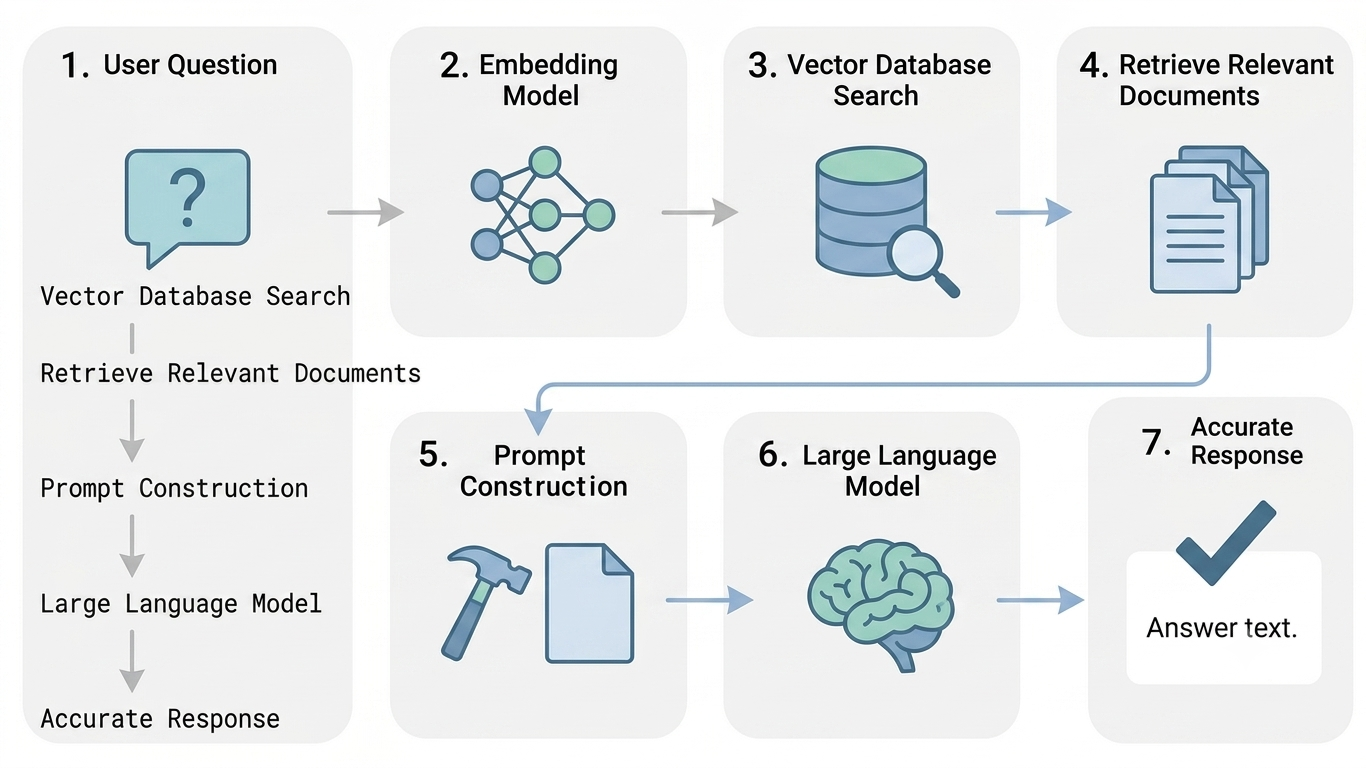
Let’s understand each step.
Step 1: Data Collection
Collect all knowledge sources.
Examples:
- PDF files
- Word documents
- FAQs
- Database records
- Websites
- Markdown files
- Emails
- Product documentation
Step 2: Document Chunking
Large documents are split into smaller sections.
Example:
Instead of storing a 200-page PDF as one record:
Chunk 1
Chunk 2
Chunk 3
Chunk 4
...
Chunking improves retrieval accuracy.
Step 3: Generate Embeddings
Each chunk is converted into a vector (numerical representation).
Instead of matching keywords, AI matches meaning.
Example:
Question: How can I reset my password?
The system can retrieve:
Forgot Password Guide
Even though the exact words differ.
This is called semantic search.
Step 4: Store in a Vector Database
Embeddings are stored inside a vector database.
Popular choices include:
- Pinecone
- Weaviate
- Qdrant
- Milvus
- ChromaDB
- pgvector (PostgreSQL)
These databases efficiently find semantically similar content.
Step 5: User Asks a Question
Example:
How many OTP attempts are allowed?
The system converts the question into an embedding.
Step 6: Retrieve Relevant Documents
Instead of scanning every document, the vector database retrieves the most relevant chunks.
Example:

OTP Policy Maximum Attempts: 5
Expiration: 10 minutes
Resend Limit: 3
Step 7: Generate the Final Answer
The retrieved documents are added to the prompt.
Example:
Context: Maximum OTP attempts = 5

Question: How many attempts are allowed?
The LLM now answers using your documentation instead of guessing.
RAG Architecture
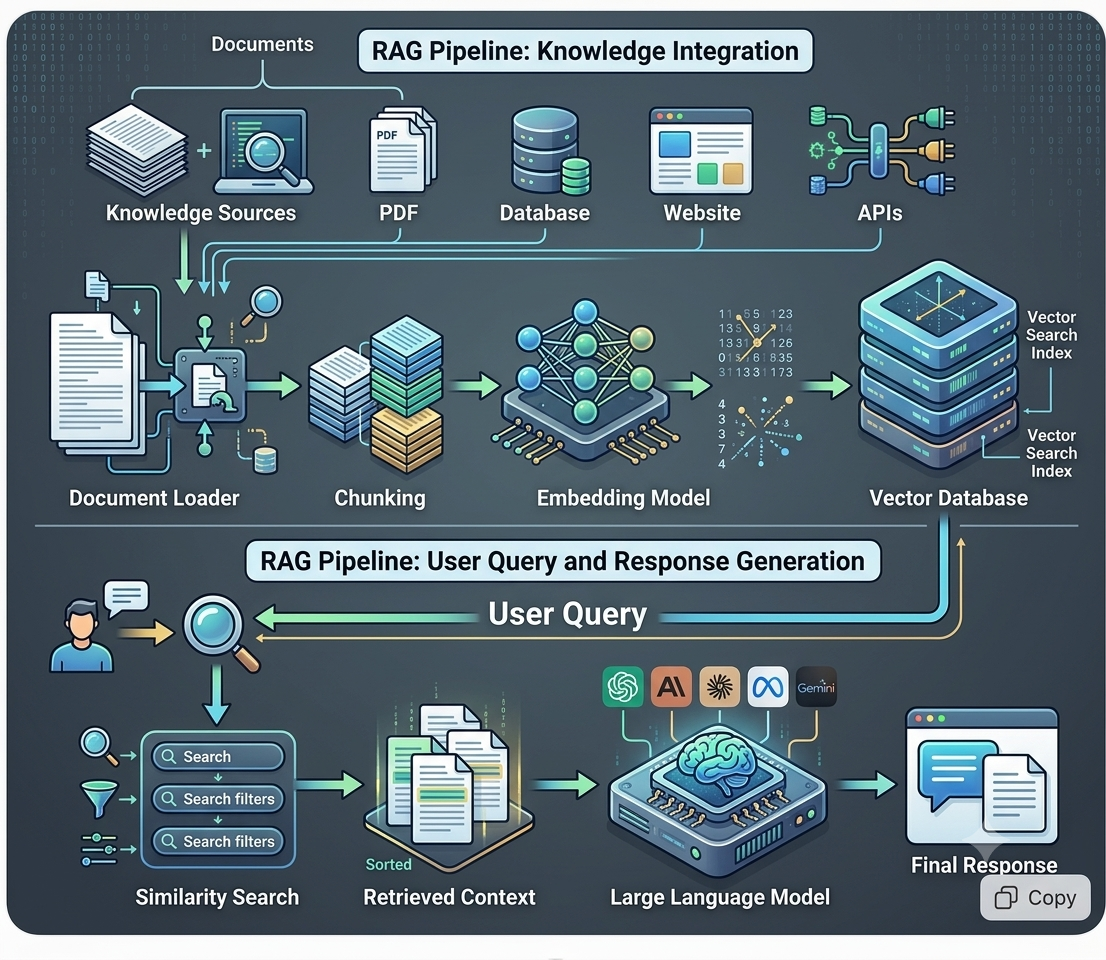
Components of a RAG System
| Component | Purpose |
|---|---|
| Document Loader | Reads source documents |
| Chunker | Splits documents into smaller pieces |
| Embedding Model | Converts text into vectors |
| Vector Database | Stores embeddings |
| Retriever | Finds relevant chunks |
| Prompt Builder | Combines question with retrieved context |
| LLM | Generates the final answer |
Benefits of Using RAG
1. More Accurate Answers
Responses are grounded in your own data instead of relying solely on model memory.
2. Reduced Hallucinations
Providing relevant context significantly lowers the chance of fabricated information.
3. No Model Retraining
Simply update your knowledge base—no need to retrain the LLM.
4. Real-Time Knowledge
New documents become searchable immediately after indexing.
5. Lower Operational Costs
Maintaining a RAG pipeline is often far more cost-effective than repeated fine-tuning.
6. Enterprise Security
Keep sensitive data within your infrastructure while controlling exactly what the AI can access.
RAG vs Fine-Tuning
| Feature | RAG | Fine-Tuning |
|---|---|---|
| Uses external data | ✅ | x |
| Easy to update | ✅ | x |
| Expensive | Low | High |
| Training required | No | Yes |
| Reduces hallucinations | Yes | Limited |
| Best for company documents | Excellent | Moderate |
| Real-time information | Yes | No |
Real-World Use Cases
AI Customer Support
Answer customer questions using the latest product manuals and FAQs.
Internal Knowledge Assistant
Help employees find information from:
- HR policies
- Technical documentation
- Standard operating procedures
Healthcare
Retrieve information from approved clinical guidelines before generating responses.
Legal Research
Search contracts, regulations, and case law to provide grounded answers.
Financial Services
Answer compliance and policy questions using current internal documentation.
Developer Documentation
Enable engineers to query APIs, SDKs, architecture docs, and code examples in natural language.
Popular RAG Technology Stack
LLMs
- OpenAI GPT
- Claude
- Gemini
- Llama
Embedding Models
- OpenAI Embeddings
- BAAI BGE
- E5
- Sentence Transformers
Vector Databases
- Pinecone
- Qdrant
- Weaviate
- Milvus
- ChromaDB
- pgvector
Frameworks
- LangChain
- LlamaIndex
- Haystack
- DSPy
Best Practices for Building a RAG System
Use High-Quality Documents
Poor-quality or outdated data leads to poor responses.
Optimize Chunk Size
Chunks that are too large dilute relevance, while chunks that are too small lose context. Experiment to find the optimal balance.
Keep Your Index Fresh
Re-index documents whenever content changes to ensure the AI always retrieves the latest information.
Apply Metadata Filtering
Tag documents with metadata such as department, language, or product version to improve retrieval precision.
Re-rank Retrieved Results
Use a re-ranking model to prioritize the most relevant document chunks before sending them to the LLM.
Monitor Performance
Track metrics like retrieval accuracy, response quality, latency, and user satisfaction to continuously improve the system.
Common Challenges
- Choosing the right chunk size
- Managing duplicate documents
- Handling multilingual content
- Retrieving the most relevant context
- Maintaining low response latency
- Keeping indexes synchronized with data updates
- Controlling access to sensitive information
Future of RAG Systems
The next generation of RAG systems is moving beyond simple document retrieval. Emerging capabilities include:
- Agentic RAG, where AI agents can plan multi-step retrieval tasks.
- Multimodal RAG, enabling retrieval from text, images, audio, and video.
- Graph RAG, which leverages knowledge graphs to capture relationships between entities.
- Hybrid Search, combining keyword search with semantic search for better accuracy.
- Multi-Agent RAG, where specialized agents collaborate to answer complex questions.
These advancements are making AI systems more context-aware, reliable, and capable of handling increasingly sophisticated enterprise workflows.
Conclusion
A RAG System (Retrieval-Augmented Generation) is transforming how AI applications deliver accurate, trustworthy, and up-to-date responses. By combining semantic retrieval with powerful language models, organizations can build assistants that answer questions using their own knowledge rather than relying on static training data.
Whether you’re developing an AI-powered customer support chatbot, an internal knowledge assistant, or an enterprise search platform, RAG offers a scalable and cost-effective alternative to frequent model fine-tuning. With the right document pipeline, vector database, and retrieval strategy, you can significantly reduce hallucinations, improve response quality, and keep your AI aligned with the latest information.
As generative AI continues to evolve, RAG is becoming a foundational architecture for production-ready AI systems. Investing in a well-designed RAG pipeline today will help you build more reliable, secure, and intelligent applications for the future.
FAQs
Q1. What does RAG stand for?
Ans. RAG stands for Retrieval-Augmented Generation, an AI architecture that retrieves relevant information from external knowledge sources before generating a response.
Q2. Does RAG replace fine-tuning?
Ans. Not entirely. RAG is ideal for frequently changing knowledge, while fine-tuning is better suited for teaching a model new behaviors or domain-specific patterns. Many production systems combine both approaches.
Q3. Do I need a vector database for RAG?
Ans. While it’s possible to build small-scale RAG systems without one, vector databases provide fast and accurate semantic search, making them the preferred choice for production deployments.
Q4. Which programming languages can be used to build a RAG system?
Ans. Popular options include Python, JavaScript/TypeScript, Java, Go, and PHP, depending on your preferred AI frameworks and infrastructure.
Q5. Is RAG suitable for enterprise applications?
Ans. Yes. RAG is widely used in enterprises for customer support, knowledge management, document search, compliance, and AI assistants because it allows AI to work with secure, up-to-date organizational data.