
Artificial Intelligence is often described as a system that learns, thinks, and improves over time. One of the most fundamental concepts behind this behavior is looping.
Whether you’re building AI applications, training machine learning models, creating AI agents, or simply using tools like ChatGPT, Claude, or Gemini, you’ve already encountered different forms of AI loops—even if you didn’t realize it.
Looping allows AI systems to repeatedly analyze data, evaluate results, improve decisions, and continue working until a goal is achieved.
In this guide, we’ll explore what looping in AI means, the different types of AI loops, practical examples, and best practices for implementing loops effectively.
What is Looping in AI?
Looping in AI refers to the repetitive execution of tasks, reasoning processes, or learning cycles until a desired outcome is achieved or a stopping condition is met.
Unlike traditional programming loops that simply repeat instructions, AI loops often involve:
- Learning
- Decision making
- Evaluation
- Improvement
- Re-planning
- Self-correction
Instead of repeating identical actions, AI systems may produce better results during each iteration.
Think of it like this:
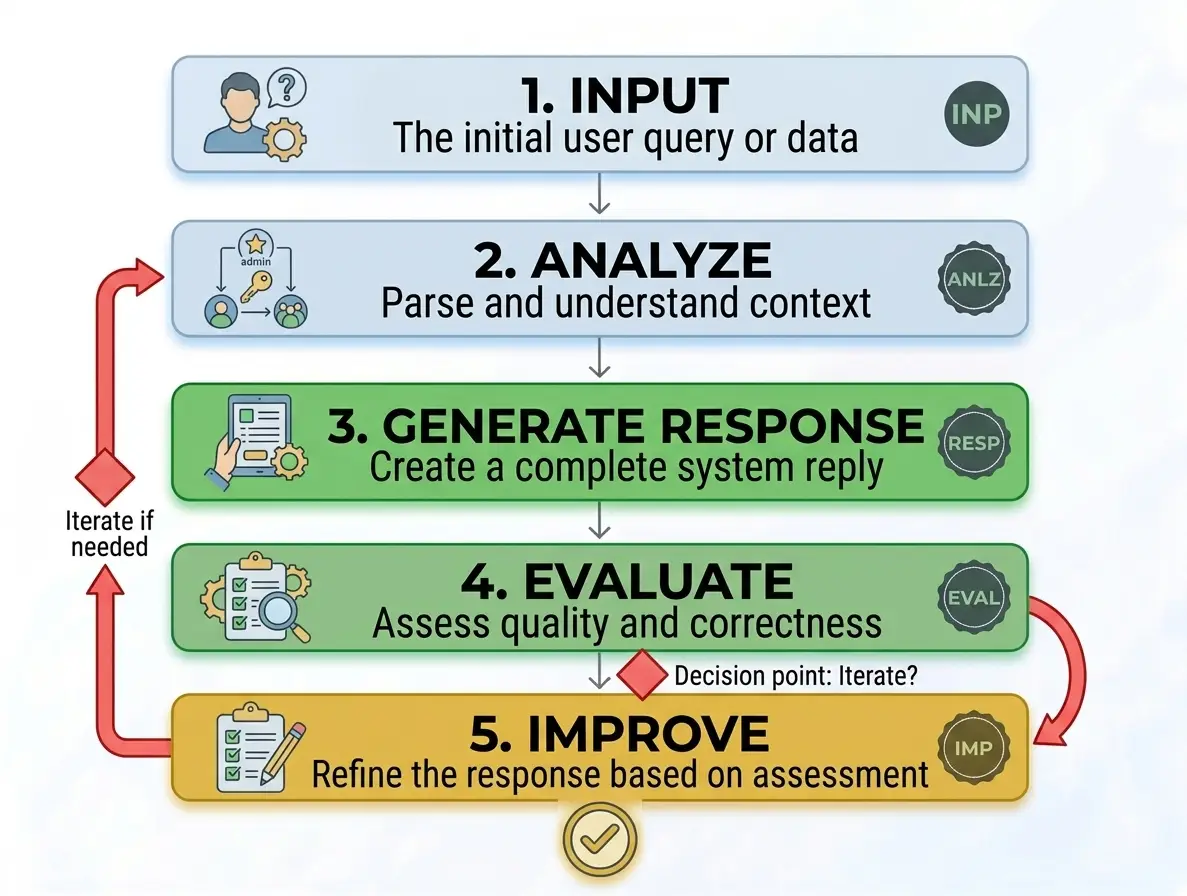
This continuous improvement process is known as an AI loop.
Why Looping is Important in AI
Without looping, AI would simply generate one output and stop.
Modern AI systems need loops because they must:
- Learn from previous attempts
- Correct mistakes
- Refine responses
- Handle complex tasks
- Break large problems into smaller ones
- Interact with external tools
- Continue until objectives are completed
This makes AI systems more intelligent and reliable.
Types of Looping in AI
1. Training Loop (Machine Learning)
The most common AI loop is the training loop.
A machine learning model repeatedly:
- Reads data
- Makes predictions
- Calculates errors
- Updates weights
- Trains again
Example:
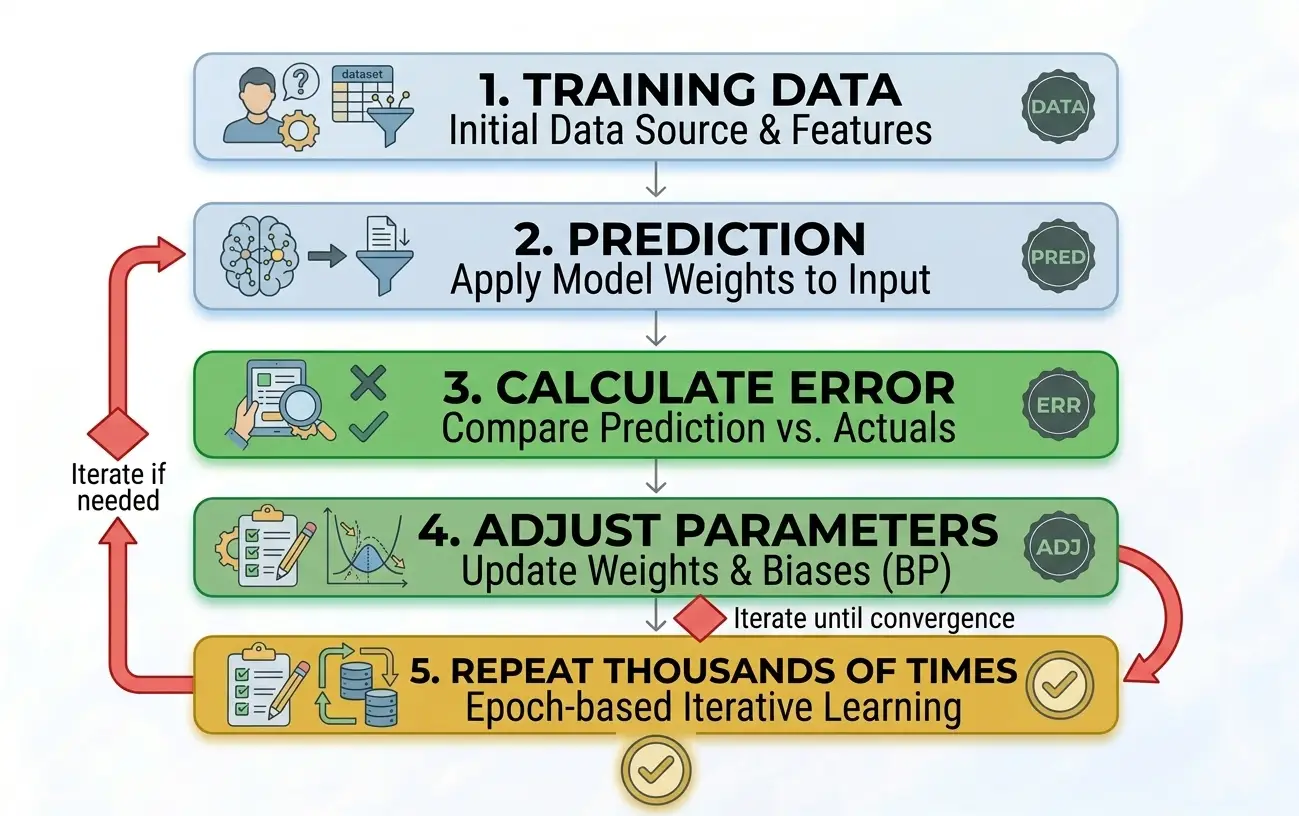
Every iteration improves model accuracy.
2. Feedback Loop
A feedback loop helps AI improve based on outputs or user interactions.
Example:
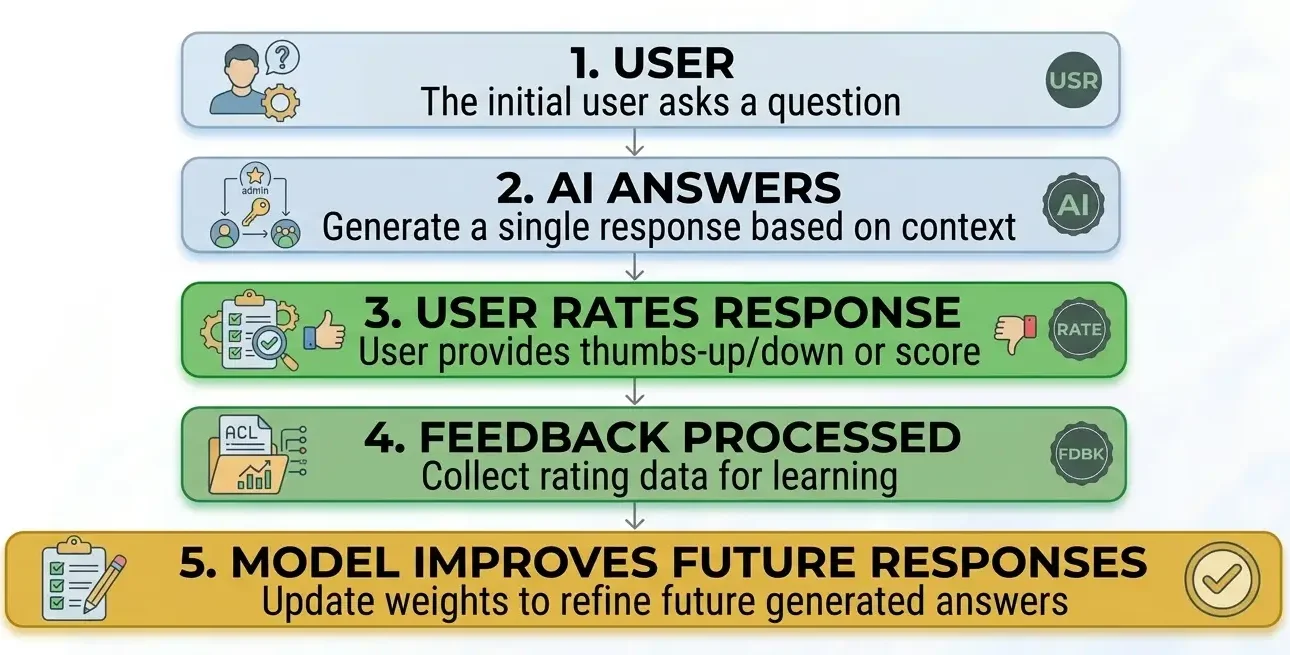
This is common in:
- Chatbots
- Recommendation systems
- Search engines
- Personalized AI assistants
3. Reasoning Loop (LLMs)
Modern Large Language Models (LLMs) don’t always answer immediately.
Instead, they may internally perform reasoning steps like:
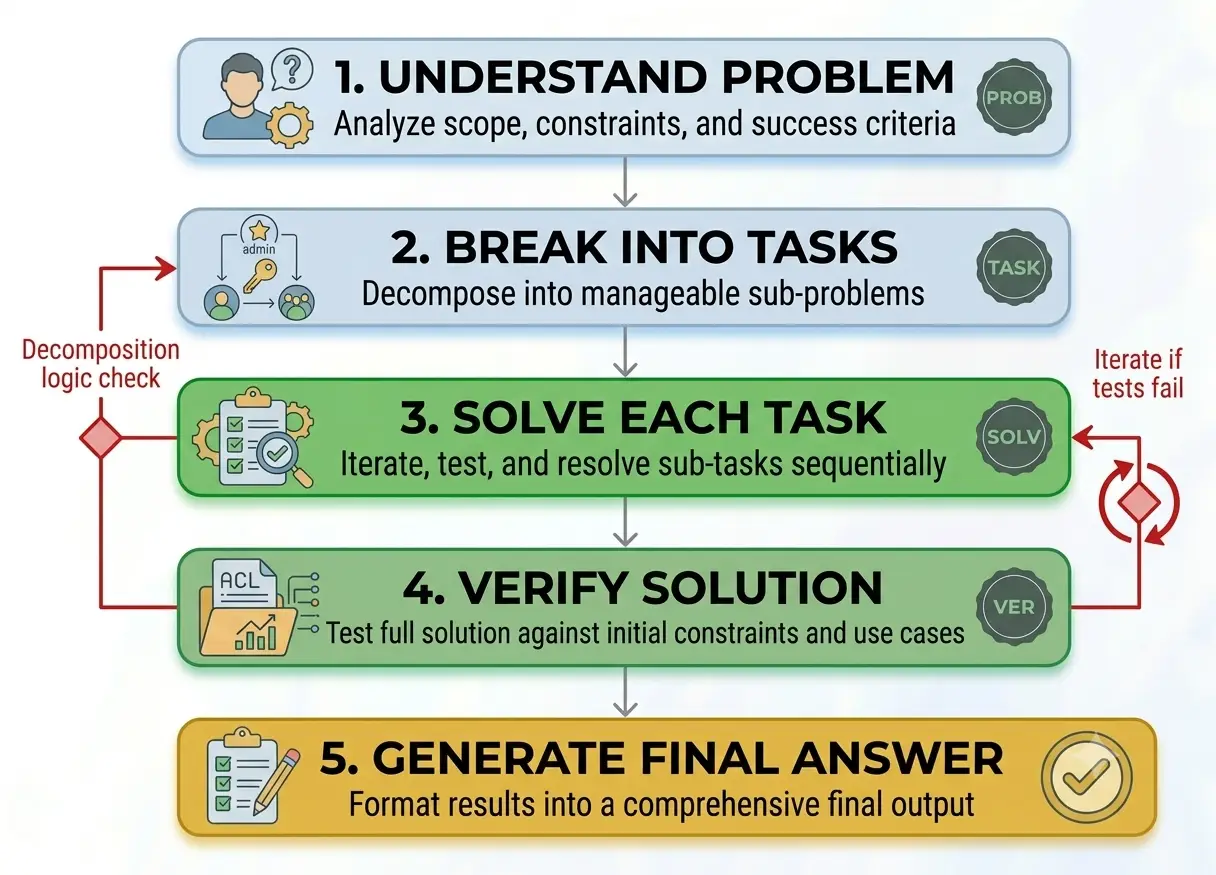
Advanced prompting techniques such as Chain-of-Thought and Reflection rely on iterative reasoning to improve answer quality.
4. AI Agent Loop
AI agents work continuously until objectives are completed.
Typical agent workflow:
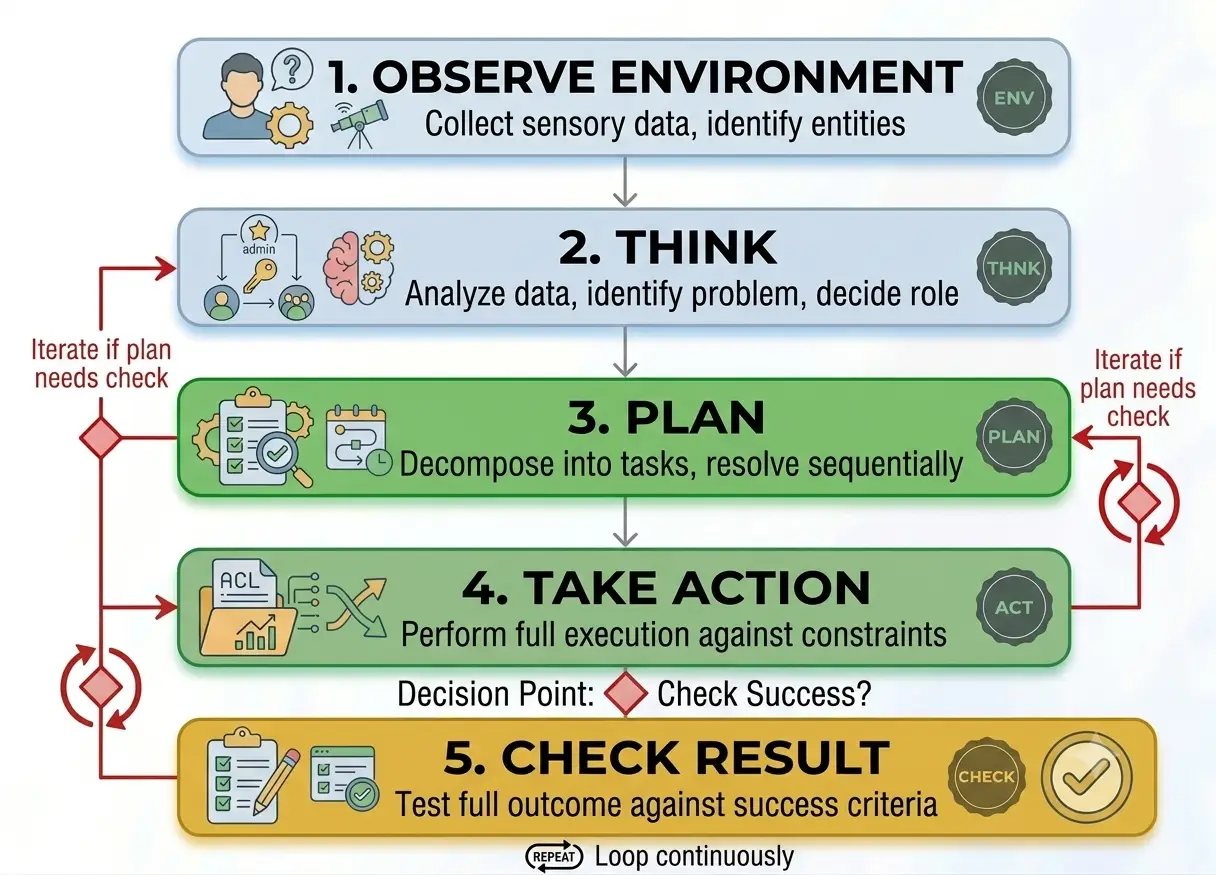
Example:
An AI coding assistant:
- Reads your repository
- Plans modifications
- Updates code
- Runs tests
- Fixes errors
- Tests again
- Creates a pull request
This entire workflow is an agent loop.
5. Reinforcement Learning Loop
Reinforcement Learning uses rewards to teach AI.
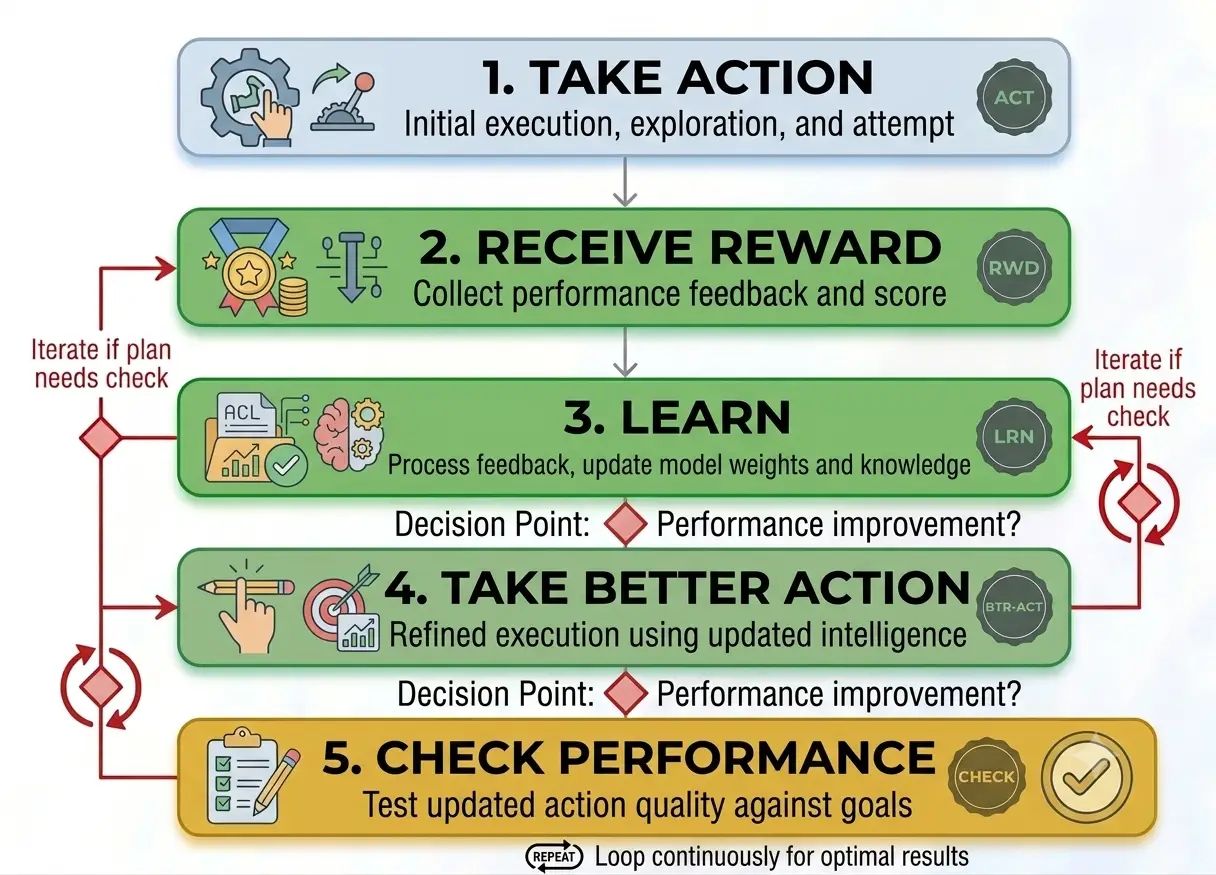
Examples include:
- Self-driving cars
- Robotics
- Chess engines
- Game-playing AI
- Industrial automation
Looping vs Traditional Programming Loops
| Traditional Programming | AI Loop |
|---|---|
| Repeats fixed instructions | Learns during iterations |
| Same output for same input | Output can improve over time |
| Static logic | Adaptive decision making |
| No learning | Continuous improvement |
| Usually developer-controlled | Often data-driven |
Real-World Examples of AI Looping
ChatGPT
When you ask:
“Write a blog on AI.”
The AI typically:
- Understands the prompt
- Identifies intent
- Plans the structure
- Generates content
- Checks coherence
- Produces the final response
This internal reasoning is a form of looping.
AI Coding Assistants
When fixing bugs:
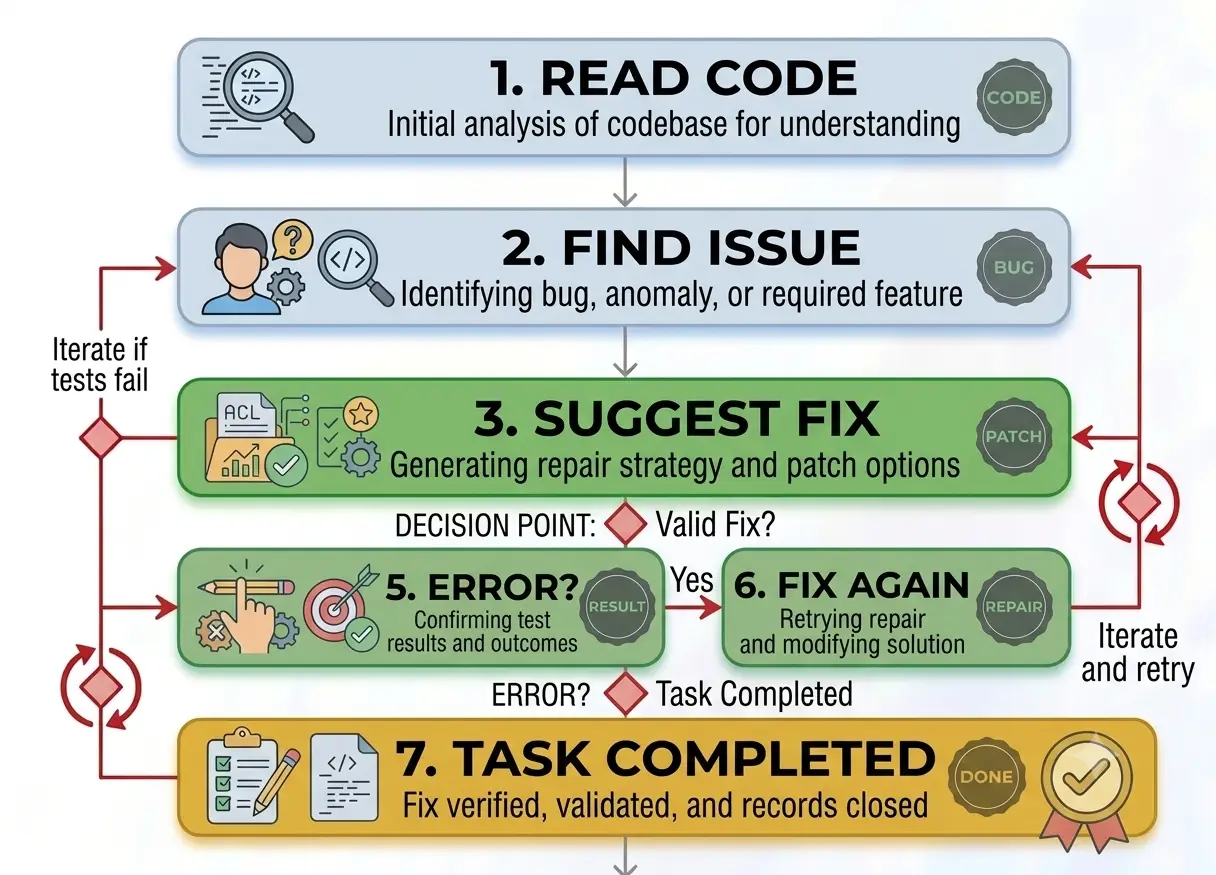
The process continues until tests pass or no further progress is possible.
Recommendation Systems
Platforms like Netflix or Spotify continuously refine recommendations by:
- Tracking user behavior
- Updating preferences
- Recalculating similarity scores
- Delivering improved suggestions
This feedback cycle is another AI loop.
AI Loop Example in Pseudocode
while not task_completed:

    observe_environment()

    plan_next_action()

    execute_action()

    result = evaluate()

    if result == success:
        task_completed = True
This simple pattern forms the basis of many AI agents.
Benefits of Looping in AI
Looping provides several advantages:
- Continuous learning
- Better accuracy
- Error correction
- Adaptive decision-making
- Improved automation
- Smarter recommendations
- Efficient problem solving
- Autonomous workflows
- Reduced manual intervention
Challenges of AI Looping
Although powerful, looping introduces challenges:
Infinite Loops
Poor stopping conditions can cause AI to repeat indefinitely.
Higher Costs
Each iteration consumes compute resources and increases inference costs.
Latency
More iterations can lead to slower response times.
Error Propagation
If the evaluation process is flawed, mistakes may be reinforced across iterations.
Resource Usage
Complex loops demand additional CPU, GPU, memory, and API calls.
Best Practices for AI Loops
To design effective AI loops:
- Define clear stopping conditions.
- Limit the maximum number of iterations.
- Validate outputs after each loop.
- Log every iteration for debugging.
- Prevent repeated failures with fallback strategies.
- Monitor execution time and resource consumption.
- Continuously evaluate model performance.
These practices help build efficient and reliable AI systems.
Where Looping is Used
Looping powers many AI applications, including:
- AI chatbots
- Virtual assistants
- Autonomous AI agents
- Robotics
- Machine learning training
- Fraud detection
- Healthcare diagnostics
- Recommendation engines
- Self-driving vehicles
- AI code generation
- Business process automation
Future of AI Looping
As AI agents become more autonomous, looping will play an even larger role. Future systems will be able to:
- Break complex goals into manageable tasks.
- Coordinate multiple specialized AI models.
- Learn continuously from interactions.
- Self-correct without human intervention.
- Execute long-running workflows with minimal oversight.
Frameworks such as LangGraph, AutoGen, and similar orchestration tools already use sophisticated looping mechanisms to enable multi-step reasoning and collaborative agent workflows.
Future of AI Looping
As AI agents become more autonomous, looping will play an even larger role. Future systems will be able to:
- Break complex goals into manageable tasks.
- Coordinate multiple specialized AI models.
- Learn continuously from interactions.
- Self-correct without human intervention.
- Execute long-running workflows with minimal oversight.
Frameworks such as LangGraph, AutoGen, and similar orchestration tools already use sophisticated looping mechanisms to enable multi-step reasoning and collaborative agent workflows.
Conclusion
Looping is one of the core mechanisms that enables AI systems to move beyond static responses. By repeatedly observing, reasoning, acting, and evaluating, AI can improve accuracy, adapt to changing conditions, and solve increasingly complex problems.
Whether you’re training a machine learning model, building an AI agent, or integrating an LLM into your application, understanding how loops work will help you design more efficient, reliable, and intelligent AI systems.
As AI continues to evolve, mastering the concept of looping will become an essential skill for developers, data scientists, and AI practitioners.
Frequently Asked Questions (FAQs)
Q. What is looping in AI?
Ans. Looping in AI is the process of repeatedly performing actions, reasoning, learning, or evaluation until a specific goal is achieved or a stopping condition is met.
Q. Is looping the same as a programming loop?
Ans. No. A programming loop repeats predefined instructions, while an AI loop often adapts its behavior based on feedback, learning, or intermediate results.
Q. Why are AI loops important?
Ans. AI loops enable continuous improvement, error correction, autonomous decision-making, and iterative problem-solving, making AI systems more effective and intelligent.
Q. What is a feedback loop in AI?
Ans. A feedback loop allows an AI system to use outcomes, user interactions, or evaluation metrics to refine future decisions and improve performance over time.
Q. Where are AI loops commonly used?
Ans. AI loops are used in machine learning training, LLM reasoning, AI agents, recommendation systems, robotics, fraud detection, autonomous vehicles, healthcare, and business automation.